Skip to the content
Good to know
Six things about the hermit crab
HomeA borrowed house
A hermit crab has a soft, curly tail with no armour, so it tucks it into an empty sea snail shell for protection.
MovingMoving house
As it grows it needs a bigger shell. It checks an empty one over carefully with its claws, then swaps in a second.
DoorShutting the door
When it pulls back inside, its bigger right claw blocks the opening like a door.
ShellsWhich shells?
Small hermit crabs in rock pools often use periwinkle or dog whelk shells. Big ones offshore use whelk shells.
LodgersLodgers on the roof
Sea anemones and other small animals sometimes live on a hermit crab's shell and get carried about.
SpottingA shell that walks
If a shell in a rock pool gets up and walks off in a hurry, there's a hermit crab inside.
The real thing
Photos of the hermit crab
 Photo: Olivier Dugornay (IFREMER, Pôle Images, Centre Bretagne - ZI, CC BY 4.0, Wikimedia Commons
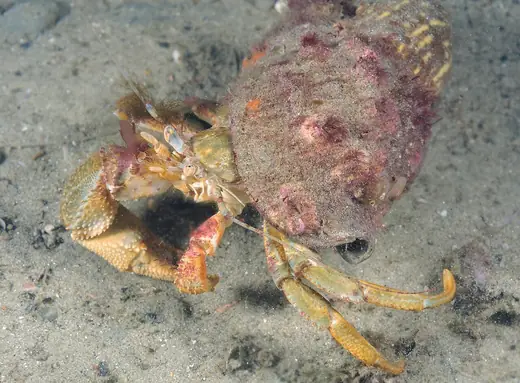 Photo: Olivier Dugornay (Ifremer), CC BY 4.0, Wikimedia Commons
 Photo: Olivier Dugornay (IFREMER, Pôle Images, Centre Bretagne - ZI, CC BY 4.0, Wikimedia Commons
Out and aboutHow to spot one
Watch the bottom of a clear rock pool for a sea snail shell that suddenly gets up and hurries off. Keep still: they come out again after a minute.
Lend a handHow to help
Leave empty shells on the beach. Every shell taken home is one fewer house for a growing hermit crab.
Following youLadybird
Who should follow you?
These live somewhere else: choosing one takes you to their page.
Bees and hoverflies
Butterflies and moths
Dragonflies and damselflies
Beetles, hoppers and ants
Not insects at all
Snails and spiders aren't insects: a snail is a mollusc, and spiders have eight legs.
These live somewhere else: choosing one takes you to their page.
Garden birds
Pond animals live on the Pond page: choosing one takes you there.
Pond life
These live somewhere else: choosing one takes you to their page.
Night garden
Rock pool life
These live somewhere else: choosing one takes you to their page.
Woodland animals
These live somewhere else: choosing one takes you to their page.
Under a log
These live somewhere else: choosing one takes you to their page.
Meadow life
River animals live on the River page: choosing one takes you there.
River life


_(Ifremer_00682-79427).jpg)
_en_rade_de_Brest_(Ifremer_00558-67031_-_20660).jpg)
_(Ifremer_00552-66430).jpg)